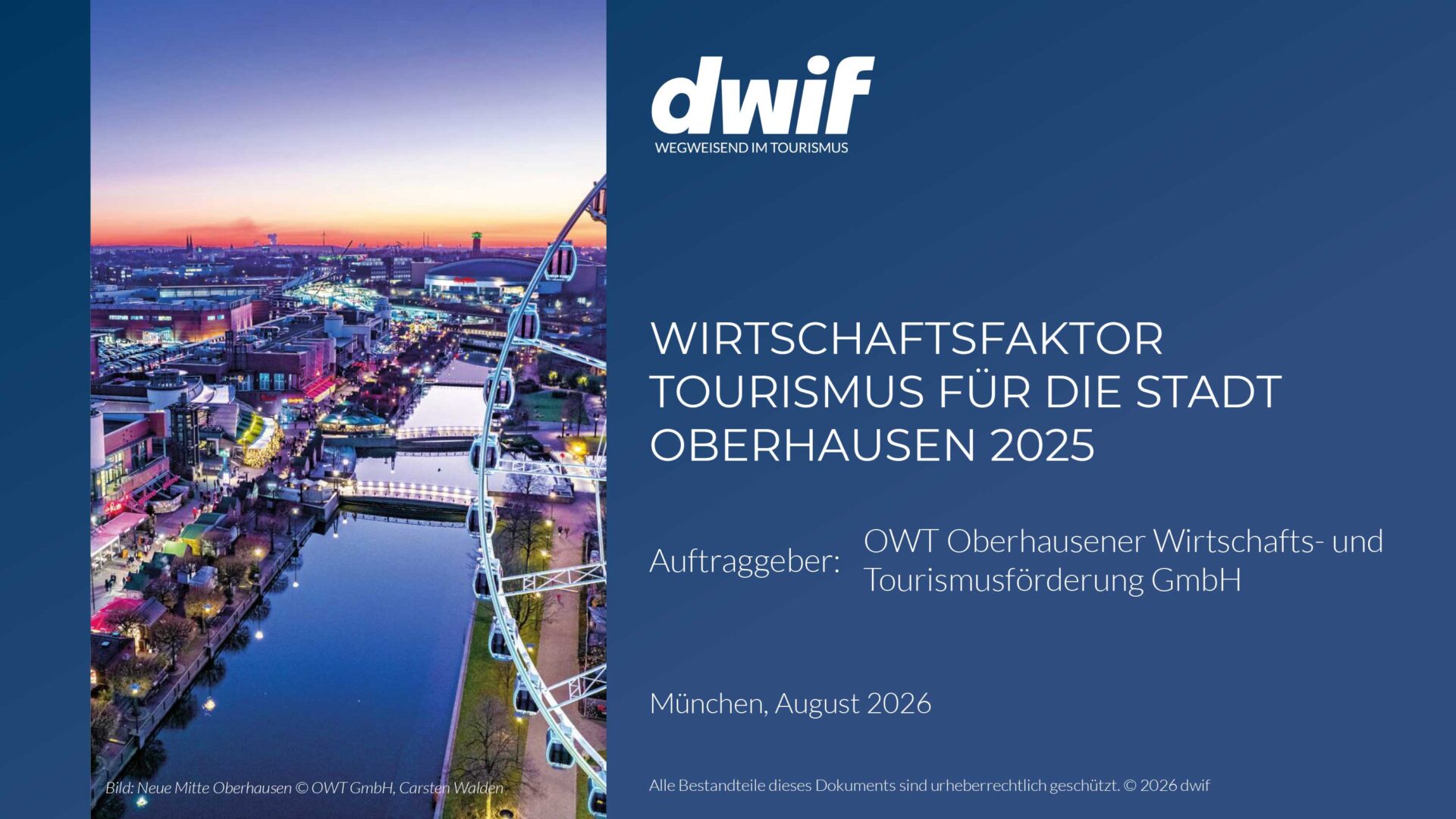
Tourism as an economic factor in 2025:
Tourism in Oberhausen generates €835 million in revenue annually.
New study confirms high economic importance of the leisure and tourism industry for trade, services and the labor market in Oberhausen
Tourism is one of the most important economic drivers in Oberhausen. This is the conclusion of an analysis by dwif-Consulting GmbH, based in Munich and Berlin. OWT Oberhausener Wirtschafts- und Tourismusförderung GmbH (Oberhausen Economic and Tourism Development Corporation) commissioned the study due to the city's dynamic development in the tourism and leisure sector. Comparable data was last collected in 2016. This provided Oberhausen's tourism officials with ample reason to reassess the economic importance of tourism for the city.
In 2025, tourism activities in Oberhausen generated gross revenues totaling €835 million. The hospitality industry, including hotels and restaurants (€239,6 million), benefited not only from the spending of visitors to the city. The largest share of tourist spending went to retail (€474,7 million), while other service sectors contributed €120,7 million. Compared to 2016, this figure represents a nominal increase in revenue of 83,3 percent – and this growth persisted despite all intervening and current crises. According to OWT and dwif, the market in Oberhausen has thus performed better than the state of North Rhine-Westphalia as a whole.
Oberhausen: A magnet for day visitors
The importance of day tourism for Oberhausen is particularly noteworthy. Day visitors generate approximately 87 percent of the city's total tourism revenue, amounting to €727,5 million. This study confirms Oberhausen's outstanding significance as a leisure, shopping, and entertainment destination with supra-regional appeal. This is further evidenced by the so-called "tourism intensity": 15 million visitors annually and over 680.000 overnight stays result in a value of 73,6 per capita for Oberhausen. By comparison, this figure for the entire Ruhr region was 38,6 in 2024.
Tourism: Value creation secures jobs
Mayor Thorsten Berg therefore emphasizes the important role of tourism for the city: “The results impressively demonstrate that tourism is far more than just a welcome leisure activity for visitors. It strengthens Oberhausen as a business location, creates income and jobs, and secures a significant portion of the added value in numerous sectors. The residents of Oberhausen also benefit from the diverse range of offerings. While other places are experiencing a decline in shopping and leisure opportunities, our strong position also enhances the quality of life in our city.”
OWT Managing Director Dr. Andreas Henseler emphasizes the significant impact of tourism on the local job market: “The economic value created by tourism is equivalent to approximately 10.800 full-time jobs. These jobs have a crucial advantage: they are created locally and cannot simply be relocated. We must continue to build on this strength in the future. We see considerable growth potential, particularly in trade fairs, congresses, and events. This benefits not only hotels and restaurants, but also many other businesses and employees in the region.”
Engine of success: New Center Oberhausen
For Rainer Suhr, head of tourism and marketing at OWT, the course taken so far is definitely paying off: “Investments in popular tourist attractions such as Topgolfthe Metronom-Theater, OBEX or most recently Karls Adventure Village, the many other successful leisure attractions such as the Gasometer or Sea Life Furthermore, the professional location marketing of all involved parties has a positive impact on visitor numbers, thereby strengthening local purchasing power and quality of life.” Oberhausen, with its settlement policy against the backdrop of structural change, has focused entirely on city tourism since at least 1996, thus taking an extremely bold path: “With success: An increase of over 800 percent in overnight stays since the opening of the New Center Oberhausen – this is unparalleled in Germany. We now generate one in every eight euros in the tourism and leisure industry, a sector that didn't even exist here 30 years ago. Therefore, we are very pleased to be working together with the Westfield Centro and to be able to celebrate the 30th anniversary of Neue Mitte with all our other partners.”
The public sector also benefits.
According to dwif, the city budget in 2025 also received approximately €24,3 million in direct tourism-related tax revenue, including shares of trade tax, income tax, sales tax, property tax B, and entertainment tax. For Diana Pinnow, Senior Consultant for Economic Analyses at dwif, these economic effects are another important aspect of the study: "Tourism in Oberhausen not only strengthens local businesses but also directly improves the municipality's financial flexibility."
About the study: The study "Tourism as an Economic Factor for the City of Oberhausen 2025" was conducted by the German Institute for Tourism Research (dwif) and analyzes the economic effects of tourism based on current demand, revenue, and value-added data. The institute drew on official visitor figures, official statistics, regional economic indicators, as well as its own surveys and databases. The institute, headquartered in Munich and Berlin, is one of the most renowned tourism economics consultancies in Germany.
5807 characters, excl. heading
© Tourism as an economic factor for the city of Oberhausen 2025, dwif Munich, August 2026
Press contact:
OWT Oberhausen Economic and Tourism Promotion GmbH, Michael Schmitz, Tel. (0208) 850 36-36, E-Mail: michael.schmitz@owtgmbh.de, Centroallee 269, 46047 Oberhausen